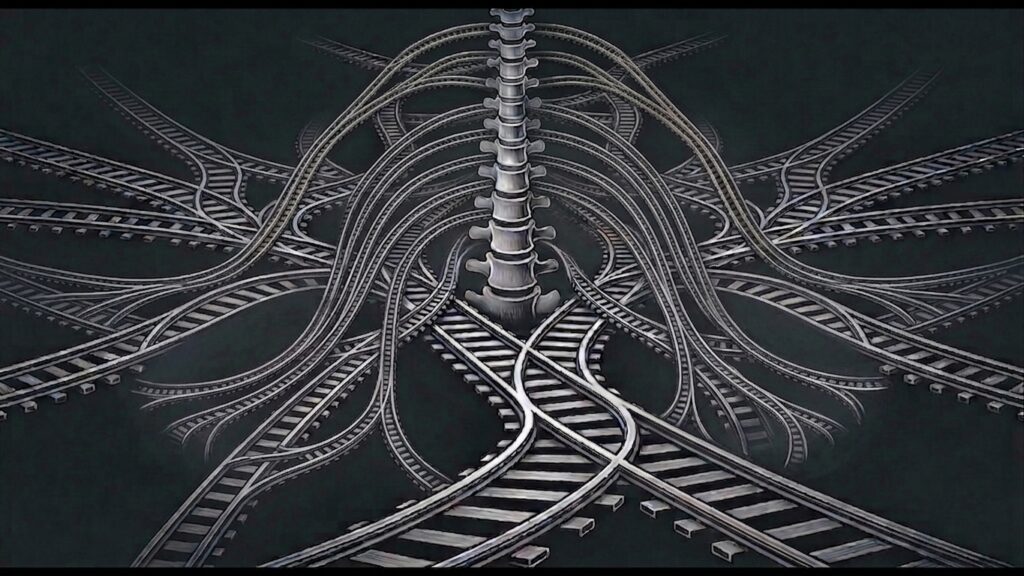
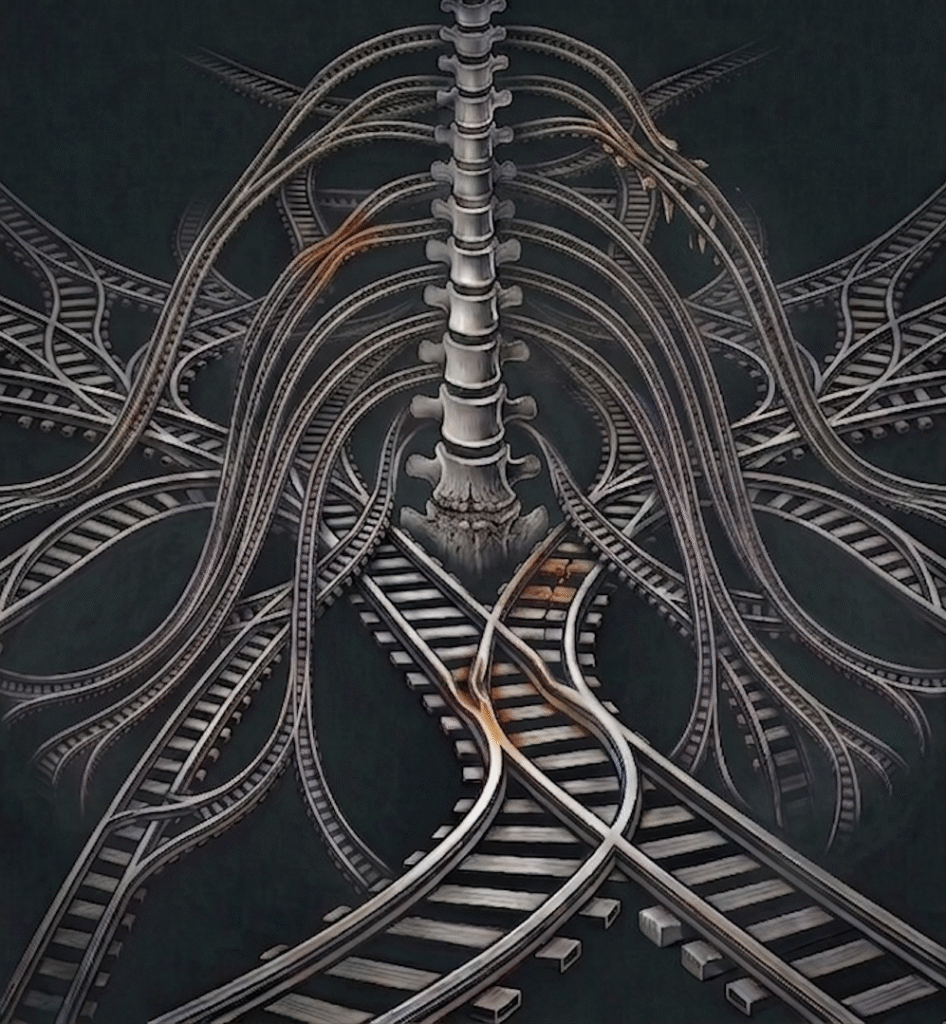
When I share my approach with my clients—including Orthopedic surgeons and specialists who understand the human body inside out—I use a simple analogy.
Think of your spine as a central train station
It’s the master hub.
And every structure feeding in and out of that station are the tracks.
These are your nerves, blood vessels, deep fascia, and surrounding soft tissue. Muscles, ligaments and tendons to name a few.
Over time, the train station itself begins to break down. Stenosis (spinal canal narrowing), disc collapse, and bulges are the most common structural breakdowns at the hub.
Out on the tracks, you get stiffness, soft-tissue scarring, fascial adhesion, and mechanical compromise (Your body moving differently, and beginning to damage and breakdown other areas).
There is also a third, highly potent element at play here— a specific dynamic force I don’t reveal publicly, simply because too many online and offline practitioners attempt to copy the concept without the deep biomechanical knowledge to execute it safely.
A completely healthy 'train station' and 'tracks'
Damage in multiple areas to both the 'station' and the 'tracks'
Here's Why Most Treatments Fail
When most people get treated for back pain, focus is always on one isolated spot in the station.
You can tell when this happens because you’re given a name for it. Like ‘sciatica’, ‘disc bulge/herniation’ or a ‘pinched nerve’. With the goal to patch up that one spot.
In physics you don’t solve labels. You solve problems.
The Unbroken Method™ uses physics principles combined with other scientific components to solve the real core problem. In doing so, restoring and rebuilding both the train station AND the tracks.
Does that track?
I’ll be totally honest with you —I wouldn’t have mastered this system had I not been fortunate enough to gain access to elite, old-school Eastern Bloc scientific systems.
To my knowledge, very few practitioners in the world possess these types of skills using this level of biomechanical precision.
The Imaging Disconnect
Let’s look at how this applies to diagnosis:
You have lower back pain, so you get an MRI.
Most imaging only inspects the train station (looking for bulges, bone spurs, and narrowed canals etc…).
But if the MRI comes back relatively “clean” and you’re still in agonizing pain, the breakdown may not be at the hub—it might be out on the tracks.
Solving back pain for long term requires restoring both the station and the entire rail network.
The Treatment Disconnect (ex. Disc Herniations)
Now let’s look at treatment.
Say you’re diagnosed with a disc bulge. The mainstream advice is almost always general physical therapy, basic core bracing, planks, or light cardio.
But a true disc herniation requires a completely different approach than other back injuries.
You need very specific mechanical decompression to occur at the train station, while simultaneously correcting the force vectors on the tracks coming and going.
Think of it like adjusting the angle and pull of heavy cables so the load isn’t concentrated on a single point.
Unless a disc has progressed past a point of permanent structural damage, the goal is to alter the physical forces acting on that segment so the disc can decompress, re-centralize, and heal naturally.
The Physics of Real Relief
Whether your pain started from an acute event (like a car crash) or years of cumulative micro-trauma, physics and mechanical force vectors were the root cause.
And applied physics is the only way to reverse it.
I dive deep into exact mechanical principles in the video below. It contains a level of foundational knowledge I keep off public social media, where recycled surface-level advice has likely already cost you time, money, or trust in people who claimed to have the answer.
Watch the video below to see how these physics apply to your spine: